LA TIMES ICU availability in Southern California at 0% amid deluge of COVID-19 patients
ICU availability in Southern California at 0% amid deluge of COVID-19 patients
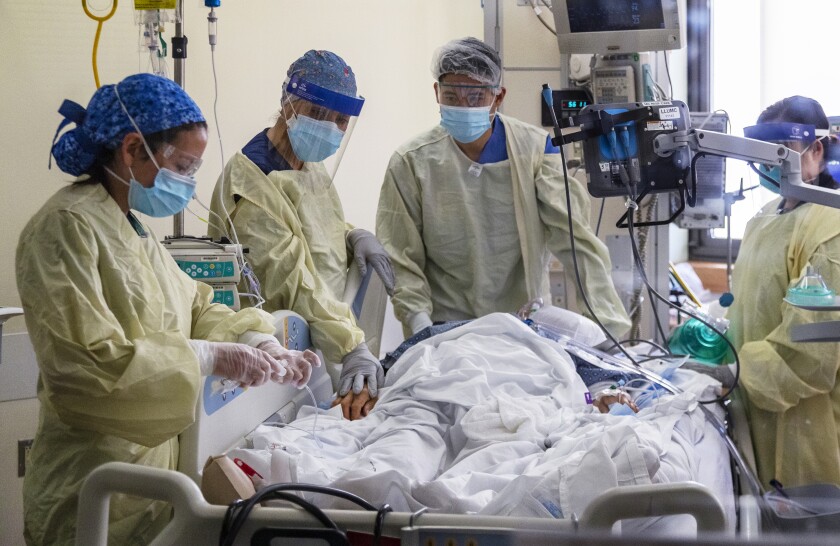
The availability of intensive care unit beds throughout Southern California reached critical mass Thursday, with 0% open, the latest sign of how the worst wave of the coronavirus is hammering hospitals and pushing healthcare systems to their limits.
Though officials have noted that the number of available ICU beds changes constantly as new patients are admitted or stabilized, the number of unoccupied beds in California’s most populous region has steadily eroded as hospitals have been flooded by unprecedented numbers of COVID-19 patients.
ICU availability throughout Southern California — which the state defines as Imperial, Inyo, Los Angeles, Mono, Orange, Riverside, San Bernardino, San Diego, San Luis Obispo, Santa Barbara and Ventura counties — had been a scant 0.5% Wednesday before falling further Thursday.
The San Joaquin Valley — which has hit 0% availability in its ICUs a few times in recent days, most recently Wednesday — saw that number tick up slightly Thursday, to a still-perilous 0.7%.

When an ICU reaches 0% capacity, hospitals likely place patients in open beds elsewhere, such as emergency
department rooms. However, without the specialized training of ICU medical professionals, the quality of care can decline and mortality rates can rise.
The percentage reflects how much of the hospital’s typical ICU capacity remains. Once those beds are full, the hospital goes into surge mode, which can accommodate 20% over its usual capacity.
“You hear we’re at 0%. That doesn’t mean we have no ICU beds or staff available at all. It means we’re into a surge,” Gov. Gavin Newsom said Monday.

COPD flare-ups can be challenging, but we've got information...
For adults with COPD, what feels like a cold or lung infection, could actually be signaling a COPD flare-up.
California is now opening temporary field hospitals to help with overflow patients. The field hospitals will care for non-ICU patients in places such as Costa Mesa, Porterville, Sacramento, Imperial and Orange County; other facilities are on standby status in Riverside, Richmond, Fresno, San Diego and San Francisco.
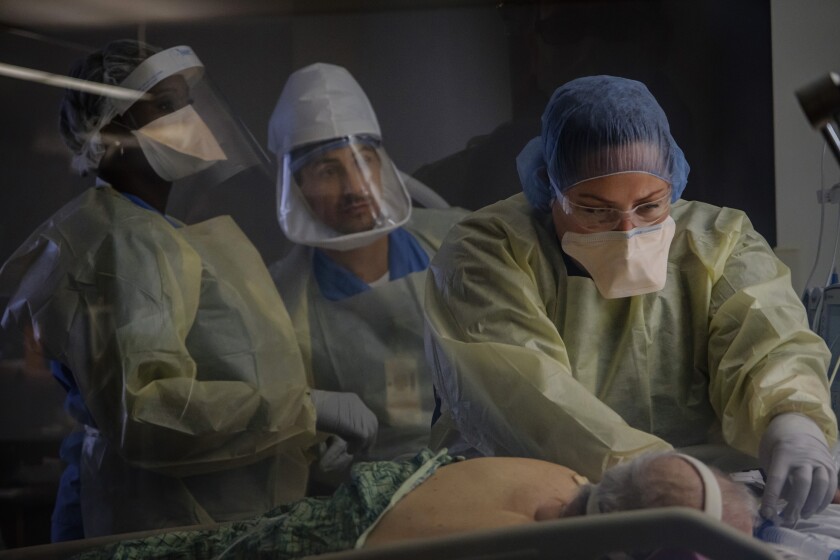
The number of people hospitalized in California for COVID-19 has broken records for 18 consecutive days. On Tuesday, the most recent data available, 14,939 people across the state were in hospitals with coronavirus infections — more than six times larger than the comparable number on Halloween.
Because of the lagging nature of the novel coronavirus, it can take two to three weeks for spikes in cases to trigger a corresponding increase in hospitalizations. When that happens, though, the consequences can be sudden and severe. State officials have previously estimated that 12% of newly diagnosed coronavirus cases are likely to require hospitalization, with 12% of those eventually ending up in the ICU.
That means, the most recent record-high hospitalizations do not account for the sky-high numbers of new infections, a chilling prospect for the state’s stretched-thin hospitals and healthcare workers.
There were nearly 1,000 people with COVID-19 in L.A. County’s intensive care units as of Tuesday; forecasts say that by early January, there could be between 1,600 to 3,600 COVID-19 patients in need of ICU beds if virus transmission trends remain the same. There are only 2,500 licensed ICU beds in L.A. County.
“There are simply not enough trained staff to care for the volume of patients that are projected to come and need care,” Dr. Christina Ghaly, the county’s director of health services, said Wednesday. “Our hospitals are under siege, and our model shows no end in sight.”
Hospitals in L.A. County are filling up as never before. For much of September and October, about 100 patients a day with COVID-19 were being newly admitted into hospitals in L.A. County daily. Just before Thanksgiving, nearly 300 new patients a day were being admitted.
Now, there are about 600 new patients with COVID-19 needing hospital admissions daily, and officials expect that that could rise to anywhere from 750 new COVID-19 patients a day to 1,350 a day by New Year’s Eve.
“If the numbers continue to increase the way they have, I am afraid that we may run out of capacity within our hospitals,” said Dr. Denise Whitfield, associate medical director with the L.A. County emergency medical services agency and an emergency room physician at Harbor-UCLA Medical Center near Torrance. “And the level of care that every resident in Los Angeles County deserves may be threatened just by the fact that we are overwhelmed.”
The surge in coronavirus cases continues to reach record proportions. For the first time, a Los Angeles Times county-by-county tally found more than 50,000 new coronavirus cases and nearly 400 deaths in California reported in a single day. The Times survey Wednesday night found 51,724 new coronavirus cases reported in a day, shattering the state’s single-day record set on Monday, when 42,088 cases were reported.
The Times tally also found 393 COVID-19 deaths Wednesday across California, breaking the record set Tuesday, when 295 deaths were recorded. Cumulatively, California has now reported 1.7 million coronavirus cases and 21,887 COVID-19 deaths.
The state is now recording an average of 203 COVID-19 deaths a day over a weekly period, and 35,200 daily cases — both records, and both quadruple the numbers from mid-November.


Comments
Post a Comment